Mind Honey Pro Official Website › Blog › Two Rows Each
Why Arginine And Citrulline Get Two Rows Each
Four of the seven rows on this panel are two ingredients wearing four names. Splitting them is technically the more honest thing to do, and it also leaves a piece of arithmetic on the reader's side of the page that most readers will not do.
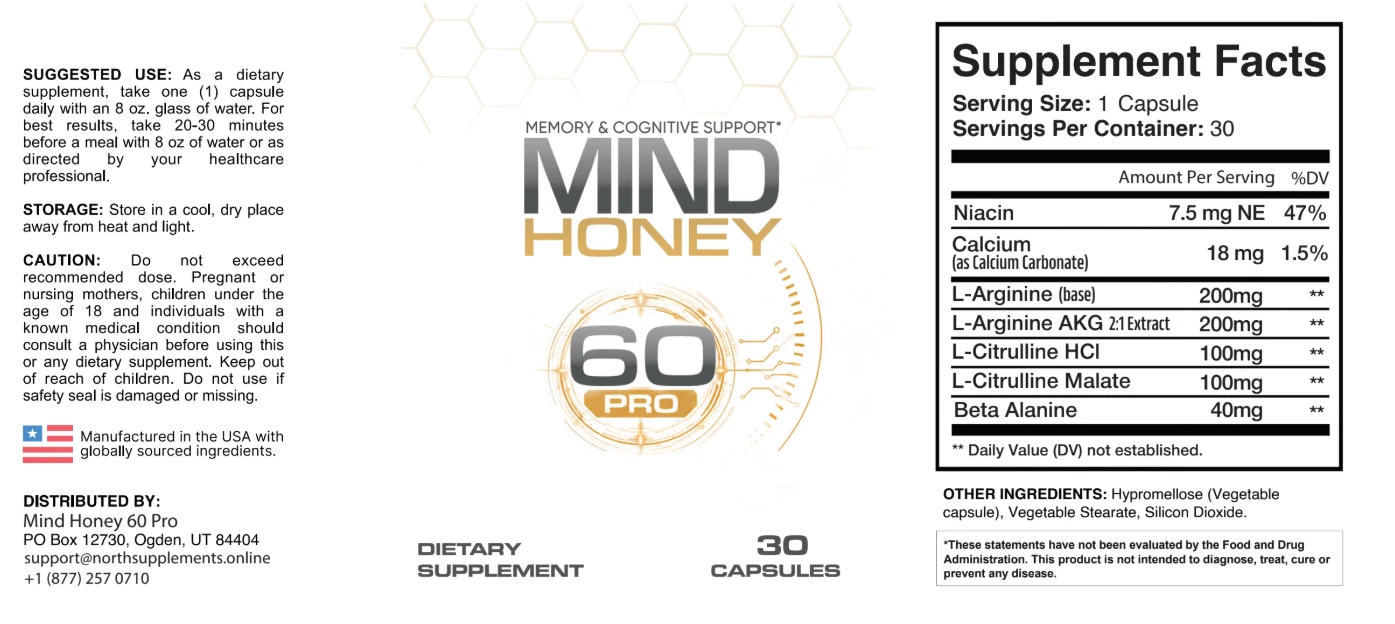
- Arginine appears as base and as alpha-ketoglutarate, 200 mg each, for a total of 400 mg.
- Citrulline appears as hydrochloride and as malate, 100 mg each, for a total of 200 mg.
- Each salt has its own literature, so naming them separately is more precise than a single combined row would be.
- It also means four smaller-looking numbers where a reader compares two larger ones against the trials.
- Citrulline is the better-absorbed of the two, and the published floor for it is 3 g twice daily.
Four rows, two ingredients
Read the middle of this panel quickly and it looks like four separate compounds. Read it carefully and it is arginine twice and citrulline twice, each in two different chemical forms.
That is a real distinction rather than a trick. A salt changes how an amino acid is absorbed, how stable it is in a capsule and, sometimes, what a trial found. Printing the forms separately tells you more than lumping them together would.
| As the panel prints it | Amount | What the second word is doing |
|---|---|---|
| L-Arginine (base) | 200 mg | Plain arginine, the amino acid itself |
| L-Arginine AKG 2:1 Extract | 200 mg | Arginine bound to alpha-ketoglutarate in a two-to-one ratio, a salt with its own pharmacokinetic literature |
| L-Citrulline HCl | 100 mg | Citrulline as a hydrochloride salt, which is how it is usually stabilised |
| L-Citrulline Malate | 100 mg | Citrulline combined with malic acid, the form the sports trials mostly used |
| Total arginine compounds | 400 mg | The addition the panel leaves to the reader |
| Total citrulline compounds | 200 mg | The same |
Four printed rows, two ingredients, two totals. The last two lines are arithmetic, not label text.
The last two lines of that table are not on the bottle. They are what a reader gets by adding the rows above them, and they are the numbers that matter for every comparison in the rest of this article.
What the alpha-ketoglutarate is for
Alpha-ketoglutarate is an intermediate of the citric acid cycle, and binding arginine to it produces arginine AKG, a compound with its own small research history separate from plain arginine.
The pharmacokinetic and training study is the reference point. It gave trained adult men 4 g three times a day, a total of 12 g, and reported on safety, plasma kinetics and exercise performance. Twelve grams is the figure to carry forward.
The rationale for the salt is that alpha-ketoglutarate has its own metabolic role, so the pairing might do more than arginine alone. Whether it does is not settled, and the literature is thin enough that the honest summary is: a plausible idea with one well-known study behind it.
The 2:1 on the label
The panel prints "L-Arginine AKG 2:1 Extract", and the ratio describes the compound rather than the dose. Two parts arginine to one part alpha-ketoglutarate is the standard commercial form. It is a specification, and printing it is a small mark of care.
What the malate is for
Malic acid is the other half of citrulline malate, and it is not inert packaging. Malate is also a citric acid cycle intermediate, and the original argument for the combination was that the two together would do more for exercise than citrulline alone.
That argument has now been tested directly. A randomised, double-blind, placebo-controlled crossover compared L-citrulline against citrulline malate on neuromuscular performance in young trained adults, using 5.3 g of citrulline with 2.7 g of malate. Comparing the two forms head to head is exactly the study this ingredient needed.
The relevant number for a label reader is not the conclusion but the dose: over five grams of citrulline, in a study whose subject was sprinting rather than remembering.
Why citrulline beats arginine on the way in
This is the counter-intuitive part of the whole category and it is worth understanding, because it explains why a well-built nitric-oxide formula leans on citrulline.
Swallowed arginine is largely broken down before it reaches the circulation, first by bacteria and enzymes in the gut and then by the liver. Swallowed citrulline is not. It passes both and is converted to arginine in the kidney, which raises plasma arginine more reliably than arginine itself does.
Schwedhelm's pharmacokinetic study is where that comparison was established, and it is also where the dose floor comes from: 3 g of citrulline twice daily. Below that the curve is flat, and a formula delivering less is not delivering a smaller effect so much as operating below the range anybody measured.
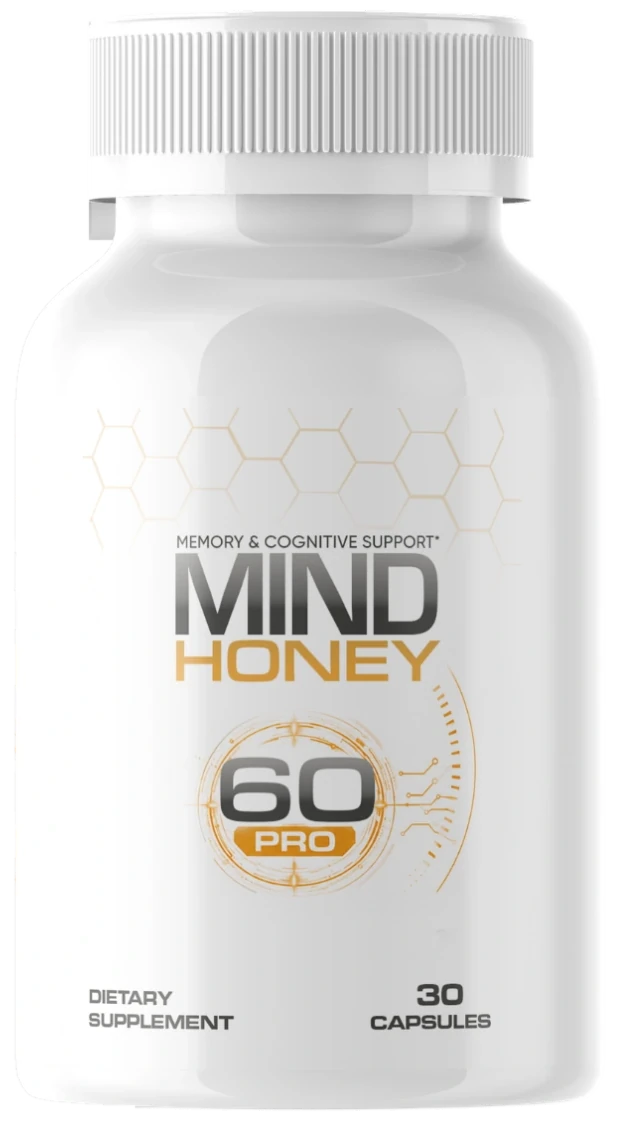
Mind Honey Pro splits its rows and prints every figure
Seven rows, four of them the two amino acids above, every amount published. One capsule a day, 30 to a bottle, and 180 days from purchase to change your mind.
Two bottles $158 · six bottles $294 · 180-day money-back guarantee
Order Mind Honey Pro On The Official WebsiteOne capsule a day · 30 per bottle · lot MIN-26/MI-4229
Doing the addition yourself
Here is the habit this article is really about. When a panel splits an ingredient, add the rows before you compare anything, because the trials measured the ingredient rather than the salt.
On this label that gives 400 mg of arginine compounds and 200 mg of citrulline compounds per capsule. Those two numbers are the ones to hold against the research, and neither of them appears anywhere on the bottle.
- Add rows that name the same ingredient in different forms, and keep the total in front of you.
- Do not add rows that name genuinely different ingredients, however similar they look.
- A salt weighs more than the amino acid inside it, so a total in compound weight is slightly generous to the label rather than harsh on it.
- Where a panel gives a blend total instead of per-row figures, none of this is possible, which is the argument for panels like this one.
The totals against the trials
| Form | What a trial used | What this bottle carries |
|---|---|---|
| L-arginine | 9 g a day in the VINTAGE MI cardiac trial | 200 mg |
| L-arginine | 6.4 g a day for 30 days in the one cognition pilot | 200 mg |
| Arginine AKG | 4 g three times daily, 12 g a day, in the pharmacokinetic study | 200 mg |
| L-citrulline | 3 g twice daily, the smallest dose that raised plasma arginine | 100 mg |
| Citrulline malate | 5.3 g citrulline with 2.7 g malate in the crossover | 100 mg |
Left column and middle column are from the methods sections. Right column is off the label.
Read the right-hand column against the middle one and the distances are large and consistent. The closest human cognition result this pair has is a 2026 pilot in older adults at 6.4 g a day for thirty days, which is thirty-two times the arginine on this panel, in a study with thirty-five completers at one hospital.
VINTAGE MI, the best-known arginine trial of all, ran 3 g three times daily in a cardiac population and is cited here for its dose rather than its outcome.
None of those trials is evidence about this capsule, in either direction. They are the scale the ingredient names were earned on, and a reader is entitled to see the scale.
What splitting a row does to a reader
Two things, and they pull in opposite directions.
It adds information. Four rows with their forms named tell you more about what is in the capsule than two rows would, and a reader who knows the difference between citrulline malate and citrulline hydrochloride is better served.
It also makes each number smaller. Two hundred milligrams twice reads as less alarming than four hundred once, and a buyer scanning a shelf sees four rows where they would otherwise see two. That is not an accusation of intent: the same split happens on labels with nothing to gain from it. It is a consequence worth naming because the fix is entirely on the reader's side and takes about ten seconds.
The one interaction worth mentioning
Arginine and citrulline both relax blood vessels, and at gram doses both lower blood pressure. A review covering the two together summarises that literature, and it is a real and reproducible effect at the amounts those trials used.
This panel sits far below those amounts, so an interaction is unlikely on the arithmetic alone. It is still the one thing on this bottle worth mentioning to whoever prescribes for you if you already take something for blood pressure, and the mention costs nothing.
The side effects page covers it once, properly, along with everything else worth knowing before a first capsule.
Four questions for any split panel
- Which rows name the same ingredient? Read past the salt to the amino acid or the vitamin underneath it.
- What do they add up to? That total is what a trial would have measured.
- Which form did the research use? Citrulline malate and plain citrulline have partly different literatures, and so do arginine and arginine AKG.
- Is the serving one unit or more? Every figure on a panel is per serving, and doubling a serving doubles a row. Here the serving is one capsule.
Run those four on this label and you get two totals, two forms each, and a comparison you can make without leaving the shop. That is more than most panels in this aisle allow, and it is the practical reason to prefer a label that prints its numbers.
References
- Schulman SP, Becker LC, Kass DA, et al. L-arginine therapy in acute myocardial infarction: the Vascular Interaction With Age in Myocardial Infarction (VINTAGE MI) randomized clinical trial. JAMA. 2006;295(1):58-64. PMID 16391217. https://pubmed.ncbi.nlm.nih.gov/16391217/
- Campbell B, Roberts M, Kerksick C, et al. Pharmacokinetics, safety, and effects on exercise performance of L-arginine alpha-ketoglutarate in trained adult men. Nutrition. 2006;22(9):872-81. PMID 16928472. https://pubmed.ncbi.nlm.nih.gov/16928472/
- Schwedhelm E, Maas R, Freese R, et al. Pharmacokinetic and pharmacodynamic properties of oral L-citrulline and L-arginine: impact on nitric oxide metabolism. Br J Clin Pharmacol. 2008;65(1):51-9. PMID 17662090. https://pubmed.ncbi.nlm.nih.gov/17662090/
- Martin-Olmedo JJ, Miras-Moreno S, Cuadra-Montes K, Garcia-Ramos A, Ruiz JR, Jurado-Fasoli L. Malate or Not? Acute Effects of L-Citrulline Versus Citrulline Malate on Neuromuscular Performance in Young, Trained Adults: A Randomized, Double-Blind, Placebo-Controlled Crossover Trial. Int J Sport Nutr Exerc Metab. 2025;35(2):89-98. PMID 39662304. https://pubmed.ncbi.nlm.nih.gov/39662304/
- Khalaf D, Kruger M, Wehland M, Infanger M, Grimm D. The Effects of Oral l-Arginine and l-Citrulline Supplementation on Blood Pressure. Nutrients. 2019;11(7):1679. PMID 31336573. https://pubmed.ncbi.nlm.nih.gov/31336573/
- Teotia S, Rana AK, Gupta V, Gupta V. Comparison of the Safety and Efficacy of Oral L-arginine for the Treatment of Cognitive Impairment in Older Adults: A Prospective, Randomized, Placebo-Controlled Pilot Study. Cureus. 2026;18(7):e112987. PMID 42621366. https://pubmed.ncbi.nlm.nih.gov/42621366/