Mind Honey Pro Official Website › Blog › Does Mind Honey Pro Really Work?
Does Mind Honey Pro Really Work? What The Label And The Research Let Us Say
Quick answer. Nobody can promise that Mind Honey Pro works for you. The label claims only memory and cognitive support, and no published trial has tested this exact formula. Five of its seven actives sit far below the amounts used in the research. The 180-day guarantee is the fairest way to test it yourself.
A fair test takes weeks and a notebook, not a leap of faith. The order page lays out the packs and the 180-day window so you can plan one.
See today’s price and guaranteeMindhoneypros is the retailer, so this button goes to our own order page and we gain if you order. Checkout shows the current price.
- The label claim is Memory & Cognitive Support. It does not claim to treat, slow or prevent any disease.
- No published trial supports a memory claim for arginine, citrulline or beta-alanine at the amounts on this label.
- Beta-alanine is 40 mg here. The one trial that moved a cognitive score in older adults used 2.4 g a day.
- Niacin at 7.5 mg NE is 47% of the Daily Value, the only row with a Daily Value.
- A thirteen-week trial that raised dietary nitrate in older adults changed neither cerebral blood flow nor cognitive function.
- No trial of this exact formula is published. Untested is not the same as disproved.
- The money-back guarantee runs 180 days from the date of purchase.
Does Mind Honey Pro really work, in one honest paragraph?
The honest answer has three parts. First, the bottle makes one claim: Memory & Cognitive Support. Second, the ingredients have a research history, but that history used much larger amounts than this capsule carries. Third, nobody has run a trial on this formula. So we cannot tell you it works, and we cannot tell you it does not. We can show you the numbers and let you judge.
If you came here for a yes or a no, that may feel unsatisfying. It is still more useful than a promise. A page that says yes without a trial behind it is guessing, and a page that says no without one is guessing too.
What is the claim, and why does the wording matter?
Memory & Cognitive Support is a structure and function statement. It is allowed because it talks about supporting a normal body function. It may not cross into disease territory. The product is not a drug, is not FDA approved, and does not treat or slow dementia.
This wording sets the ceiling for everything on this site. The seller's information pages use extra words such as focus and mental clarity. Those words are not on the label, so they are not claims you should rely on. When you judge whether the product works, judge it against the label line only.
How do the label amounts compare with the research?
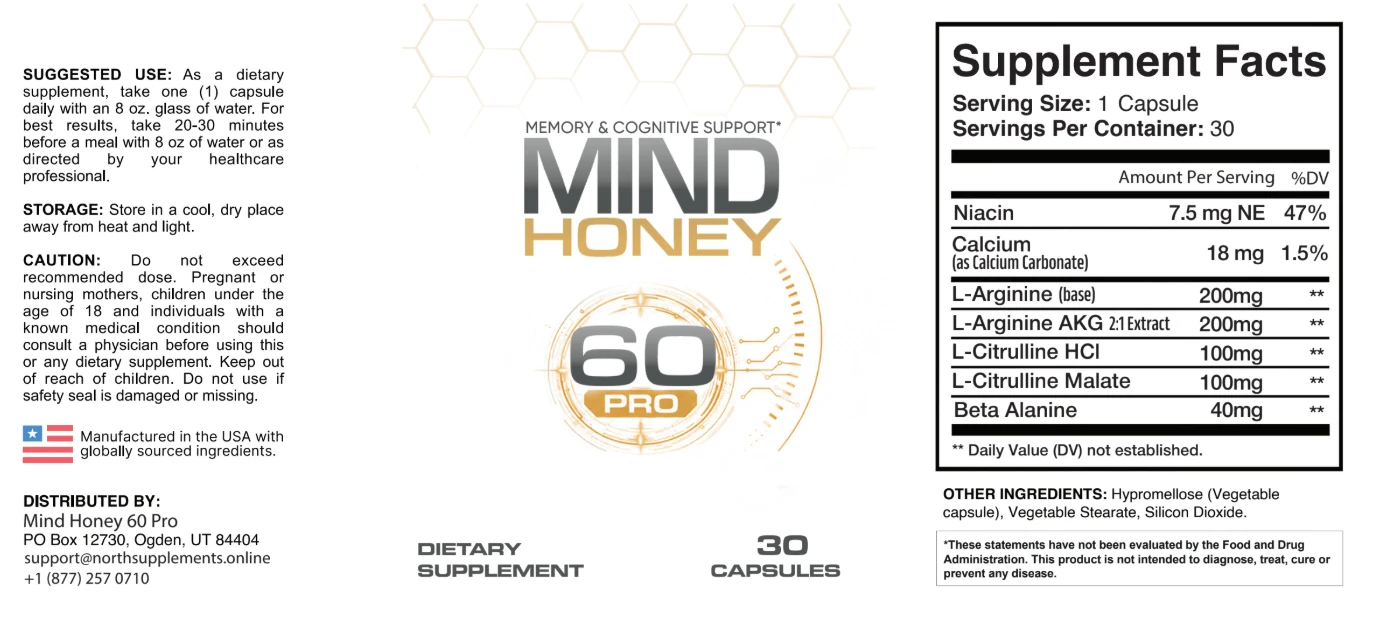
Each ingredient has a research story. The trouble is the size of the dose. The table sets the label beside the published figures named in the source material.
| Ingredient | On this label | In the published research |
|---|---|---|
| Niacin | 7.5 mg NE (47% DV) | A nutrient amount. The cognition work measured niacin eaten as food over years in a Chicago cohort. |
| L-Arginine (base) | 200 mg | 6.4 g a day for 30 days in one cognition pilot, 32 times this amount. |
| L-Arginine AKG 2:1 | 200 mg | 4 g three times daily, 12 g a day, 60 times this amount. |
| L-Citrulline HCl | 100 mg | 3 g twice daily was the smallest dose that raised plasma arginine at all. |
| L-Citrulline Malate | 100 mg | 5.3 g of citrulline in one crossover trial and 8 g a day for three days in another. |
| Beta Alanine | 40 mg | 2.4 g a day for ten weeks in older adults. 4 to 6 g a day in the ISSN position stand. |
Read the right-hand column as what researchers used, not as a forecast for this capsule.
Calcium is 18 mg, or 1.5% of the Daily Value. Treat it as a formulation ingredient, not a reason to buy.
Which row is the strongest, and why?
Niacin. It is the only row with a Daily Value, and one capsule gives 47% of it. It is also the only ingredient whose cognition research was gathered in older people, and that work looked at niacin eaten in food, not at a capsule in a trial. A population study cannot prove that a capsule helps, and the study authors say so themselves.
The amount is a nutrient amount. The famous niacin flush belongs to hundreds of milligrams of nicotinic acid and does not arise at 7.5 mg NE. So the row is safe in the plain sense, and modest in the claim sense.
What about blood flow to the brain?
Four of the seven rows feed the same pathway that helps blood vessels widen. Many shoppers assume the capsule is sold for blood flow to the brain. The label does not say that, and we do not say it for the label.
It also helps to know what the research found when it tested the idea. In a thirteen-week randomised trial, raising dietary nitrate in older adults left both cerebral blood flow and cognitive function unchanged. A mechanism that looks sensible on a diagram does not always show up in a test. That is one more reason to keep expectations small.
How can you test it fairly for yourself?
Memory is hard to judge, because the tool you use to judge it is the memory itself. A few habits make the test fairer.
- Before the first capsule, write down three specific things, such as names you forget or lists you lose. Date the note.
- Take one capsule a day, every day, with a glass of water, 20 to 30 minutes before a meal as the label asks.
- Ask one other person who sees you often to notice changes in either direction.
- Re-read your note after several weeks, not in the first fortnight. The buyer summary on this site points to 4 to 8 weeks as the wait most often described.
- Keep sleep, alcohol and routine as steady as you can, because they move memory more than any capsule does.
The 180-day guarantee gives you room to run this test and still decide against it. Opened bottles are included, and the buyer pays return postage.
When is a supplement the wrong tool?
If your memory has changed noticeably, such as getting lost in familiar places, struggling to find words, or a relative noticing before you did, see a doctor. Sleep apnoea, untreated hearing loss, thyroid function, blood pressure, alcohol and several common medicines all affect memory, and all can be checked.
A capsule cannot find any of these causes. Asking whether a supplement works is a fair question. Asking it before getting a change in memory looked at can cost you time you do not need to lose.
Frequently asked questions
Does Mind Honey Pro really work?
No one can promise it will. The label claims memory and cognitive support only. No trial of this formula is published, and five of the seven actives are far below research doses.
Is there a clinical trial on Mind Honey Pro?
No. The source material lists no published trial of this exact formula. The research named on this site tested single ingredients at much larger amounts.
Why are the amounts called low?
Because the studies used grams and the label uses milligrams. Beta-alanine is 40 mg here against 2.4 g a day in the one trial that moved a cognitive score in older adults.
Does Mind Honey Pro improve blood flow to the brain?
The label does not claim that. A thirteen-week trial that raised dietary nitrate in older adults changed neither cerebral blood flow nor cognition.
How long should I try it before judging?
Buyers most often describe a wait of 4 to 8 weeks. Nothing on the panel acts within hours, so a verdict in the first week is about expectation.
Can I get my money back if it does not work for me?
Yes. The guarantee runs 180 days from the date of purchase, opened bottles included. Return postage is the buyer's cost.
Our view
We think the fair summary is this: Mind Honey Pro is a transparent, once-a-day capsule with a modest claim and untested amounts. It may suit you as a routine, and it may do nothing you can notice. The research does not let anyone say more than that.
What you can control is the quality of your own test. Write the baseline, take it daily, wait several weeks, and use the guarantee if the answer is no. That is a better method than any promise we could print.
If you decide to run the test, the order page shows today's price and the 180-day guarantee. Nothing here is urgent.
See today’s price and guaranteeMindhoneypros is the retailer, so this button goes to our own order page and we gain if you order. Checkout shows the current price.
Sources named on this site
- Ostfeld trial in older adults (beta-alanine, 2.4 g a day for ten weeks). https://pubmed.ncbi.nlm.nih.gov/36839281/
- ISSN position stand on beta-alanine (4 to 6 g a day). https://pubmed.ncbi.nlm.nih.gov/26175657/
- Thirteen-week trial in older adults that raised dietary nitrate. https://pubmed.ncbi.nlm.nih.gov/35268027/
- Chicago Health and Aging Project (dietary niacin). https://pubmed.ncbi.nlm.nih.gov/15258207/
- A 2026 pilot trial of oral L-arginine (6.4 g a day for 30 days). https://pubmed.ncbi.nlm.nih.gov/42621366/
- Schwedhelm's dosing study (citrulline and arginine). https://pubmed.ncbi.nlm.nih.gov/17662090/
Last updated