Mind Honey Pro Official Website › Blog › The Other Ingredients
Everything Else In The Capsule: Hypromellose, A Stearate And Silica
Everyone reads the panel. Hardly anyone reads the line underneath it, which lists what the capsule is made of rather than what it delivers. On this bottle that line has three entries, and each one has a small research literature of its own. This article reads the line the way the panel is read: what each item is for, what the studies say about it, and what the label leaves unsaid.
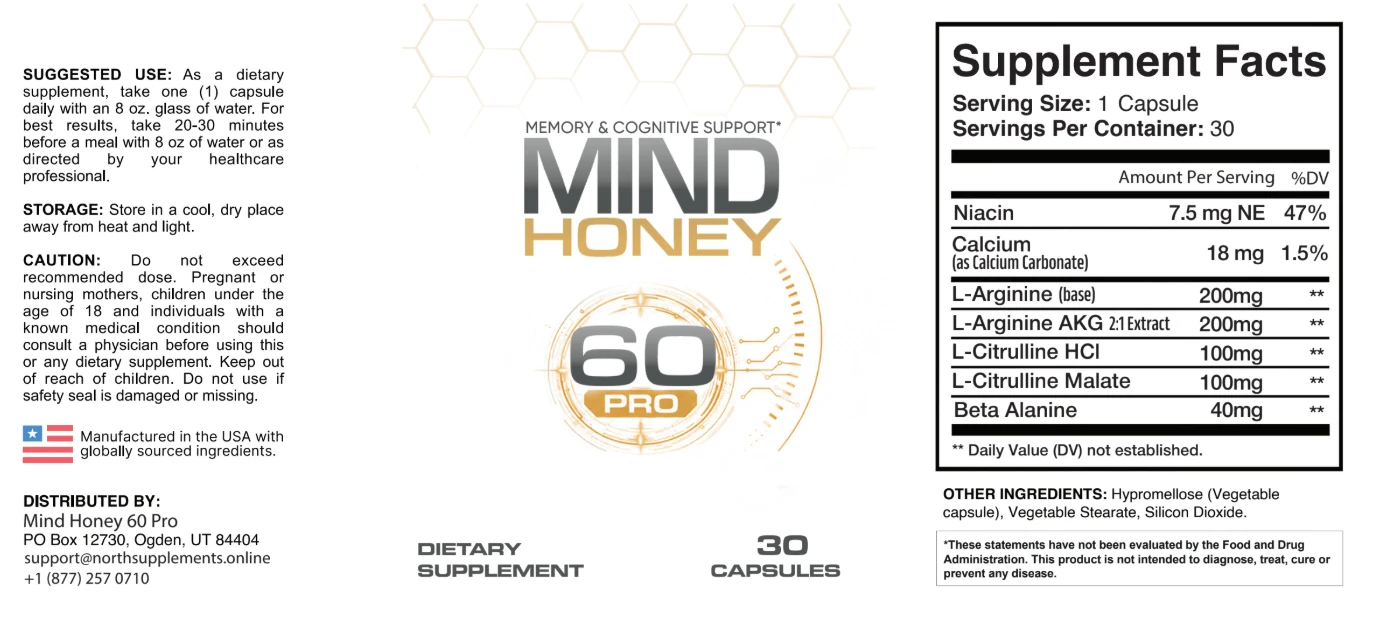
- The other-ingredients line names three items: hypromellose (vegetable capsule), vegetable stearate and silicon dioxide. It names no colour, flavour or sweetener.
- In human imaging studies of hypromellose capsules, they reached the stomach in seconds and opened there in about nine minutes fasted, against about seven for gelatin. The difference was not statistically significant.
- Laboratory studies find hypromellose absorbs less moisture than gelatin, though neither shell protects a moisture-sensitive powder. That is the practical reason behind the label’s “cool, dry place”.
- The label says “vegetable stearate” and does not name the salt. The manufacturing papers below concern capsule lubricants, magnesium stearate in one of them, and this desk does not know which stearate is in the bottle.
- The European food-safety panel found no indication of toxicity from silicon dioxide at reported use levels, and also said its specifications were insufficient because particle size is not properly characterised.
- The printed amounts add up to 665.5 mg, and the label does not print the fill weight, so nobody outside the factory can say how much of the capsule is these three items.
The three lines under the panel
Look at the artwork on the Supplement Facts page and find the small print beneath the box. It reads: Other ingredients: hypromellose (vegetable capsule), vegetable stearate, silicon dioxide. That is the entire list of what is in the capsule besides the seven printed rows.
The seven rows tell you what the capsule delivers. This line tells you what it is made of and how it was made to fill smoothly, and a short one is a reasonable sign. Every entry takes up room a more useful ingredient could have used, and there is nothing here that reads as a colour, a flavour or a sweetener. The label makes no claim beyond the names.
One arithmetic fact frames the rest. Add the seven printed amounts, 7.5 plus 18 plus 200 plus 200 plus 100 plus 100 plus 40, and you get 665.5 mg. That is a sum of printed figures, and it is not a fill weight: niacin is printed in niacin equivalents, the calcium is a mineral figure, and several rows are salts. The label does not print the capsule size or the weight of what goes into it. So the honest position is that nobody outside the factory can say how much of a capsule the other three items occupy, and this article will not guess.
Hypromellose: the shell
Hypromellose, also called HPMC, is a plant cellulose derivative, and the label describes it as a vegetable capsule. It is the usual alternative to gelatin when a manufacturer wants a shell that does not come from animals. The label itself does not say vegetarian or vegan, only “vegetable capsule”, and this desk is careful to say no more than that.
The obvious question is whether a swapped shell changes how the contents reach you. There is a small, direct human answer.
The scintigraphy study
A gamma-scintigraphy study gave eight healthy men, after an overnight fast, a hypromellose capsule and a gelatin capsule at the same time with 180 ml of water. The two capsules were radiolabelled separately so they could be followed on a camera for 30 minutes. There was no difference in oesophageal transit, and the capsules arrived in the stomach in seconds. All of them disintegrated in the stomach: the hypromellose ones after 9 ± 2 minutes and the gelatin ones after 7 ± 4, a difference that was not significant (P = 0.108).
A follow-up in fasted and fed subjects found the same pattern. Fasted, disintegration took 8 ± 2 minutes for hypromellose and 7 ± 3 for gelatin. Fed, it took 16 ± 5 and 12 ± 4. Neither comparison reached statistical significance.
The hypromellose capsules in both studies contained carrageenan as a gelling agent and were filled with lactose, in size 0, in small groups of healthy men. The Mind Honey Pro label says hypromellose and nothing about a gelling agent, and the capsule holds the seven printed actives. So these are studies of the shell material, not of this capsule.
A laboratory paper adds a wrinkle. A 2015 in-vitro comparison found that all the gelatin capsules began to disintegrate within 3 minutes and the hypromellose types within 6. Acetaminophen dissolved fastest from gelatin, above 90% in 10 minutes and independent of the medium. One of the two hypromellose capsules was influenced by pH and by what the medium contained. The authors saw room for hypromellose manufacturers to improve on gelatin’s dissolution.
Put the human and the bench data together and they fit the plain reading. A hypromellose shell may open a touch more slowly in a dish, and in the one human imaging study the difference between shells did not reach significance. Either way, the interval involved is minutes, and a capsule taken once a day for weeks is not a place where minutes matter.
The label’s timing and the shell
The suggested-use line says to take the capsule 20 to 30 minutes before a meal with 8 oz of water. That puts it closer to the fasted state the first study used, where both shells opened in under ten minutes on average. The fed-state figures matter only if you take it with food, which the label does not ask for. Nothing in either study argues for changing the routine on the how-to-use page.
Moisture, and why the label says “dry”
The storage line reads: Store in a cool, dry place away from heat and light. The label gives no reason. Some of the reasoning for the dry part appears in the capsule literature.
- A 2020 study of moisture sorption found that hypromellose capsules have weaker moisture sorption than gelatin or pullulan ones, with lower sorption rates and equilibrium moisture content, and that they protected the test contents better from outside moisture.
- A 2015 paper on moisture diffusion found gelatin took up more moisture than hypromellose at every humidity studied, yet neither shell could protect spray-dried lactose from moisture-induced changes. For less sensitive formulations it judged hypromellose the better choice.
- A 2025 comparison of inhalation capsule shells at 25 °C and 75% relative humidity found hypromellose took up moisture quickly but kept its structure, while gelatin softened and became easier to puncture. The authors stressed following the storage conditions on the pack.
- The 2015 in-vitro paper above adds that none of the capsule types, gelatin or hypromellose, protected a hygroscopic powder from the humidity around it.
The common thread is unglamorous. A capsule shell is not a sealed container, whichever material it is, and the surrounding air gets in. Several of these studies used pharmaceutical shells and drug powders, so they are a guide to the mechanism rather than a measurement of this bottle. This desk cannot say how much humidity, if any, matters for these particular amino acids, because none of the papers tested them.
What it can offer is the practical inference. A bathroom cabinet spends part of each day steamy, and a windowsill spends part of each day warm. A kitchen drawer or a bedroom shelf is neither. That is this desk’s reasoning from the label’s own words, not a finding from a trial.
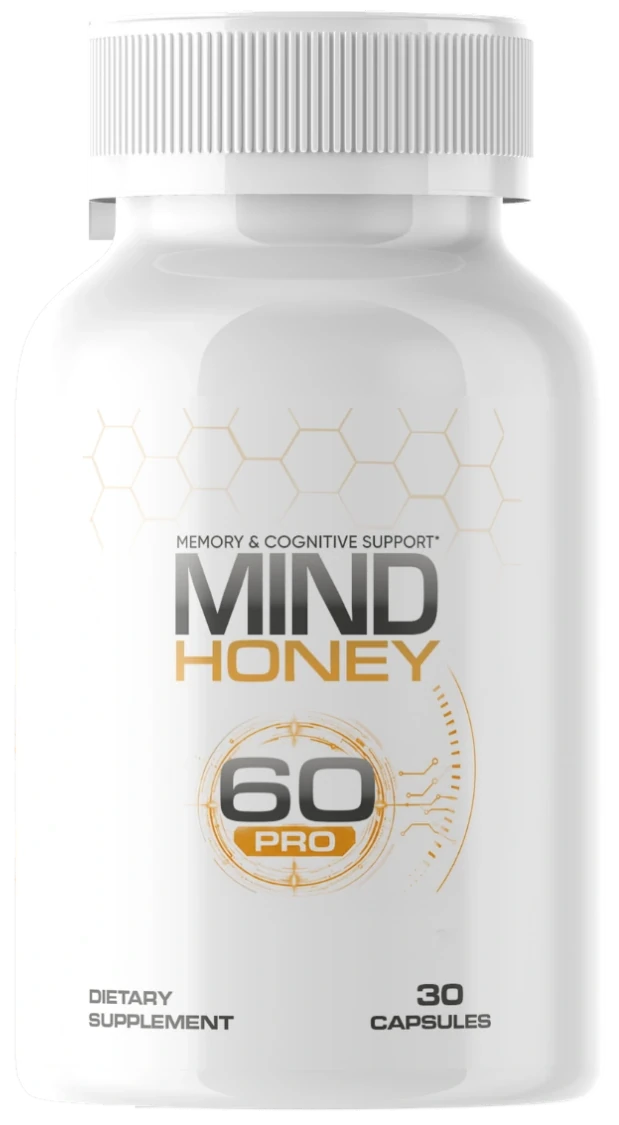
Mind Honey Pro prints its actives and names its capsule
Seven printed rows, three other ingredients, one capsule a day and thirty to a bottle, with 180 days from the date of purchase to change your mind. Where the label is silent, this desk says so rather than filling the gap.
Two bottles $158 · six bottles $294 · 180-day money-back guarantee
Order Mind Honey Pro On The Official WebsiteOne capsule a day · 30 per bottle · lot MIN-26/MI-4229
Vegetable stearate: the one the label does not name
Stearates are lubricants used to keep powder from sticking to the machinery that fills capsules. This label prints “vegetable stearate” and stops. It does not say which stearate, and there are several. The manufacturing papers this desk found concern lubricants in capsule filling, and one of them names magnesium stearate, so it is worth saying at once that this desk does not know which stearate is in the bottle. That is a question for the distributor, and the contact page is where to ask it.
Why would a lubricant be interesting at all? Because in capsule filling it is not inert to the process.
- A 2018 paper on shear in capsule filling found that the powder feed system of a dosing-disc filling machine added shear to the powder, and that further dispersing the magnesium stearate suppressed dissolution and lowered the tensile strength of the product. The shear during encapsulation, the authors noted, can be much greater than during ordinary blending.
- A 2023 paper on over-blending found that processes adding shear made blends less permeable and slowed capsule dissolution by at least 35% at the time points tested. Its disintegration test did not detect the problem, while a wettability test did.
Notice what these papers are and are not. They are pharmaceutical manufacturing studies, about drug capsules and a particular lubricant. They do not say this product has a dissolution problem, and no test result for this bottle is available to this desk. What they show is that the presence of a lubricant is less important than the process that puts it there, and that a disintegration test alone can miss a slow-dissolving batch.
That is a fair reason to care about the batch paperwork, with its limits. The lot number and certificate reference on this bottle are filing references, not laboratory proof, as this website’s own disclaimer says, and the testing and quality page covers what the seals do and do not show. A stearate line on a label is a disclosure. It is not evidence of how well the capsule was made.
Silicon dioxide: the anti-caking agent
Silicon dioxide is an anti-caking agent, there to keep a powder from clumping. It has been assessed by a regulator as a food additive, which is the most direct assessment this desk could find for the entry.
The European Food Safety Authority’s 2018 re-evaluation of silicon dioxide (E 551) says the material appears to be poorly absorbed, though silicon-containing material was found in some tissues. Despite limitations in the subchronic, reproductive and developmental studies, including those with nano-sized silicon dioxide, the panel saw no indication of adverse effects, did not find a genotoxicity concern, and noted that the highest exposure estimates were at least one order of magnitude below the no-observed-adverse-effect levels. Its conclusion on toxicity was that there was no indication of it at the reported uses and use levels.
The same document is less comfortable on a different point, and this desk would be misleading you to leave it out. The panel concluded that the EU specifications for E 551 were insufficient, because they do not exclude nanoparticles and do not require the particle size distribution to be characterised. It asked for clear characterisation and could not confirm the existing acceptable daily intake of “not specified”.
In plain terms: the food-safety body found nothing troubling at the levels people are exposed to, and asked for better specifications. Two limits apply to reading that across to this capsule. The opinion covers silicon dioxide as a food additive, not silica in a supplement, and the label does not say which form or particle size this bottle uses.
| Entry | What it is for | What the papers say | What the label does not say |
|---|---|---|---|
| Hypromellose (vegetable capsule) | The shell | Opens in the stomach within minutes, comparably to gelatin in imaging studies. Absorbs less moisture than gelatin, and neither shell is a moisture barrier. | Whether a gelling agent is used, and the capsule size. |
| Vegetable stearate | Lubricant, so powder feeds through the filling machine | In magnesium stearate studies, over-blending and shear slowed dissolution. | Which stearate, and how much. |
| Silicon dioxide | Anti-caking agent | No indication of toxicity at reported food use levels. Specifications called insufficient on particle size. | The form and particle size, and how much. |
The right-hand column is the same length as the middle one. That is what a three-item other-ingredients line usually looks like.
Five questions for any other-ingredients line
The reading transfers to any supplement, and it takes under a minute.
- How long is the line? A short one means fewer things taking up space that an active could have used. This one is three items.
- Is there anything that is not a shell or a processing aid? A colour, a flavour or a sweetener is doing something for the buyer’s eye or tongue, not the capsule. None is named here.
- Does the shell name its material? This one does, hypromellose, which is why a vegetarian reader can at least start from the label. It stops short of saying vegetarian.
- Are the processing aids named as what they are? Here the stearate is named only as “vegetable”, which is a source, not a compound.
- Is a weight printed for any of it? Here none is. That is normal for a capsule, and it means the comparison you can make is with the printed actives, not with the whole capsule.
What this changes and what it does not
It changes very little about what a buyer does, which is worth saying plainly.
- Store it as the label says. Cool, dry and out of the light. The moisture studies are about shells and powders, but they support the dry part in general terms, and the label asks for it in any case.
- Take it the way the label says. One capsule a day with a full glass of water, 20 to 30 minutes before a meal. The shell studies do not suggest that a change would help.
- Do not read the other-ingredients line as a quality mark. A short, plain list is a good sign about what is in the capsule. It is silent about how the capsule was made.
- If the stearate matters to you, ask. The label names it as vegetable and stops, and the distributor is the one who can say which one it is.
None of this is a reason to distrust the capsule and none of it is a reason to trust it more. It is the description of a line that most people scroll past, and a reminder that a label which prints its actives to the milligram is still allowed to keep some things quiet. The calcium article shows how that works in one printed row, and the article on Daily Values shows how to read the percentage column beside it.
No paper cited here studied this capsule. The shell, moisture, lubricant and silica papers describe other capsules and other powders, and they are offered as a guide to how these materials behave, not as test results for this bottle. Mind Honey Pro is a dietary supplement for healthy adults of eighteen and over, not a drug, and it is not FDA-approved.
References
- Tuleu C, Khela MK, Evans DF, et al. A scintigraphic investigation of the disintegration behaviour of capsules in fasting subjects: a comparison of hypromellose capsules containing carrageenan as a gelling agent and standard gelatin capsules. Eur J Pharm Sci. 2007;30(3-4):251-5. PMID 17188473. https://pubmed.ncbi.nlm.nih.gov/17188473/
- Jones BE, Basit AW, Tuleu C. The disintegration behaviour of capsules in fed subjects: a comparison of hypromellose (carrageenan) capsules and standard gelatin capsules. Int J Pharm. 2012;424(1-2):40-3. PMID 22214655. https://pubmed.ncbi.nlm.nih.gov/22214655/
- Al-Tabakha MM, Arida AI, Fahelelbom KM, et al. Influence of capsule shell composition on the performance indicators of hypromellose capsule in comparison to hard gelatin capsules. Drug Dev Ind Pharm. 2015;41(10):1726-37. PMID 25586554. https://pubmed.ncbi.nlm.nih.gov/25586554/
- Yang N, Chen H, Jin Z, et al. Moisture sorption and desorption properties of gelatin, HPMC and pullulan hard capsules. Int J Biol Macromol. 2020;159:659-666. PMID 32439451. https://pubmed.ncbi.nlm.nih.gov/32439451/
- Barham AS, Tewes F, Healy AM. Moisture diffusion and permeability characteristics of hydroxypropylmethylcellulose and hard gelatin capsules. Int J Pharm. 2015;478(2):796-803. PMID 25526672. https://pubmed.ncbi.nlm.nih.gov/25526672/
- Magramane S, Kállai-Szabó N, Farkas D, et al. Comparative Evaluation of Gelatin and HPMC Inhalation Capsule Shells Exposed to Simulated Humidity Conditions. Pharmaceutics. 2025;17(7):877. PMID 40733086. https://pubmed.ncbi.nlm.nih.gov/40733086/
- Blackwood D, Ketterhagen W, Kresevic J, et al. Quantifying and reducing powder shear sensitivity when manufacturing capsules with lubricants. Drug Dev Ind Pharm. 2018;44(8):1350-1356. PMID 29712481. https://pubmed.ncbi.nlm.nih.gov/29712481/
- Barrocas P, Vieira ACF, Almeida H, et al. Over-blending effect of lubricants on capsules manufacturing: a simple and fast wettability technique to predict batch dissolution performance. Pharm Dev Technol. 2023;28(3-4):363-370. PMID 36987819. https://pubmed.ncbi.nlm.nih.gov/36987819/
- EFSA Panel on Food Additives and Nutrient Sources added to Food (ANS), Younes M, Aggett P, et al. Re-evaluation of silicon dioxide (E 551) as a food additive. EFSA J. 2018;16(1):e05088. PMID 32625658. https://pubmed.ncbi.nlm.nih.gov/32625658/