Mind Honey Pro Official Website › Blog › What 47% Of A Daily Value Buys
What 47% Of A Daily Value Actually Buys You
Two rows on this panel carry a percentage and five carry a dagger. The percentage rows are the ones almost nobody reads, and on a memory capsule one of them turns out to be the best-supported ingredient in the bottle.
- A Daily Value is a labelling reference for a whole day's intake, set for nutrients that have one.
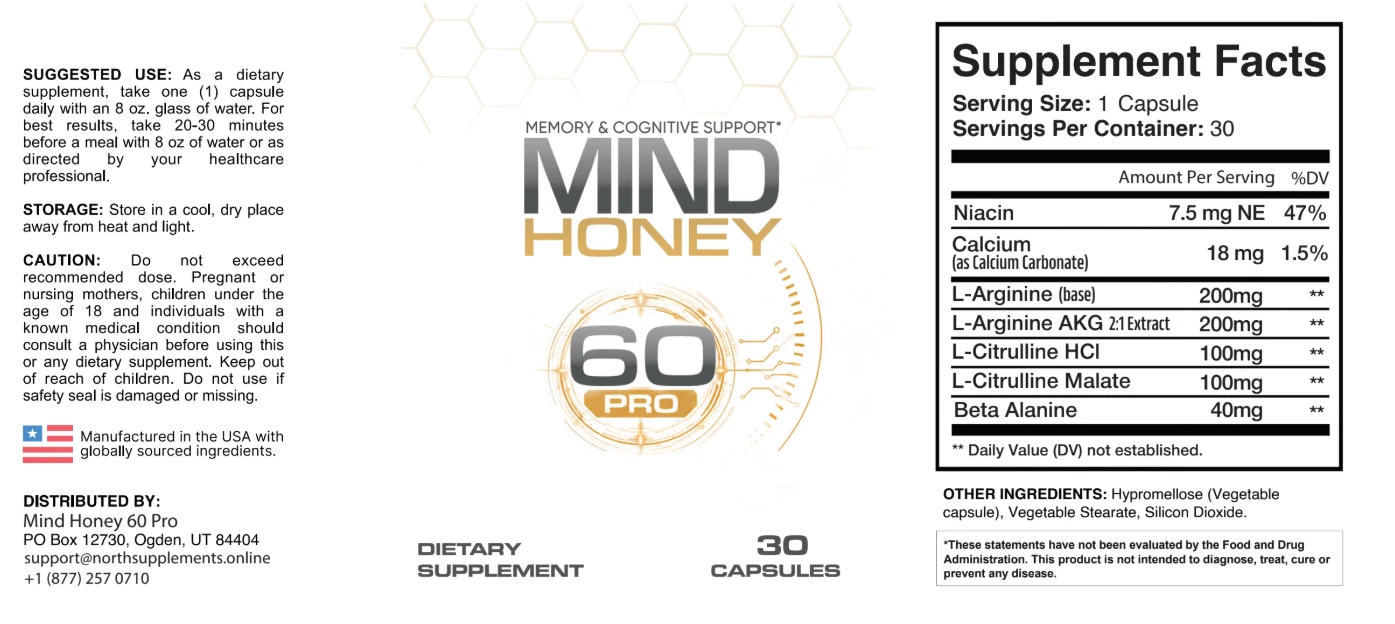
- Niacin here is 7.5 mg NE, which is 47% of that reference: nearly half a day, from one capsule.
- The calcium row is 1.5%, which is a formulation amount rather than an active one.
- Five rows carry a dagger because no Daily Value exists for an amino acid, so the percentage column cannot help and the trial dose has to.
- Niacin is also the only ingredient on this panel whose cognition literature was collected in ordinary older people rather than in athletes.
What a Daily Value actually is
A Daily Value is a single reference figure per nutrient, used on labels so that an amount in milligrams can be turned into a percentage a shopper can compare across products. It is a labelling convention rather than a personal recommendation, and it is set for one notional adult rather than for you.
That makes it a blunt instrument and a genuinely useful one. Blunt, because your own requirement varies with age, sex, pregnancy and several other things. Useful, because it puts every fortified product on one scale.
What it is not
It is not a dose. A Daily Value answers the question "how much of a day's nutrition does this contain", and nothing else. It says nothing about whether an amount does anything beyond nutrition, and for most vitamins there is no reason to expect that it would.
That distinction is the reason a percentage and a trial dose are different currencies, and the reason this panel needs both columns read.
Why the unit says NE and not mg
Niacin is printed in milligrams of niacin equivalents because the body makes some of its own. Tryptophan, an ordinary dietary amino acid, is converted to niacin at a fixed approximate ratio, so an intake figure that counted only the vitamin eaten as a vitamin would understate what arrived.
The conversion ratio study is where that arithmetic comes from: it fed a purified diet to volunteers and measured how much niacin resulted from the tryptophan in it.
A label printing NE is therefore being more precise than one printing plain milligrams, and it is a small signal about how carefully the panel was assembled.
The two rows on this panel that have one
| Row | Amount | % Daily Value | What the percentage tells you |
|---|---|---|---|
| Niacin | 7.5 mg NE | 47% | Nearly half a day's requirement of an essential vitamin. A nutritionally real amount. |
| Calcium (as calcium carbonate) | 18 mg | 1.5% | A formulation amount. Reading it as an active is the mistake the layout invites. |
| L-Arginine (base) | 200 mg | Dagger | No Daily Value exists, so the percentage column cannot help. The trial dose has to. |
| L-Arginine AKG 2:1 Extract | 200 mg | Dagger | The same, and the same reading. |
| L-Citrulline HCl | 100 mg | Dagger | The same. |
| L-Citrulline Malate | 100 mg | Dagger | The same. |
| Beta Alanine | 40 mg | Dagger | The same. |
Two rows on this panel have a percentage. Five carry a dagger, which means no Daily Value has been established for them.
Read down the percentage column and the panel splits in half. Niacin at 47% is nearly a day's vitamin from one capsule. Calcium at 1.5% is a formulation amount, present for the reasons calcium carbonate is usually present in a capsule: it flows, it bulks and it is cheap.
There is no criticism in that second sentence. Every capsule contains something doing a manufacturing job, and on this label the other-ingredients line names three more of them. The mistake is reading a 1.5% row as an active, which the panel layout quietly encourages by giving it the same visual weight as everything above it.
What a dagger in the percentage column means
Five rows on this panel carry a dagger rather than a number. The footnote it points to says the same thing every such footnote says: no Daily Value has been established.
That is a statement about the regulation rather than about the ingredient. Daily Values exist for vitamins and minerals with an established requirement. Arginine, citrulline and beta-alanine are amino acids the body either makes or obtains from protein in food, so there is no deficiency state to set a reference against.
The practical consequence is that the percentage column is useless for five of seven rows, and something else has to take its place. That something is the dose the published trials used, which is the comparison the ingredients page prints in full and the beta-alanine article works through one row at a time.
- A dagger means no established Daily Value, not "too small to measure".
- It is common and expected on amino acids, botanicals and most novel ingredients.
- It removes the only comparison built into the panel, which is why the trial dose matters more on those rows than on the vitamin rows.
- A panel with daggers on every row is not automatically worse. A panel with no amounts at all is.
Mind Honey Pro prints both columns, which is what makes this readable
Seven rows, an amount against every one, two of them with a Daily Value and five with the dagger explained above. One capsule a day and 180 days from purchase to change your mind.
Two bottles $158 · six bottles $294 · 180-day money-back guarantee
Order Mind Honey Pro On The Official WebsiteOne capsule a day · 30 per bottle · lot MIN-26/MI-4229
The one cognition literature collected in older people
Here is the part that makes the niacin row more than a vitamin contribution.
The Chicago Health and Aging Project followed dietary niacin intake in a population cohort and looked at incident Alzheimer's disease and at the rate of cognitive decline. It is observational, it measured niacin eaten as food across years, and it cannot establish cause. Confounding in nutrition cohorts is the rule rather than the exception.
It is also the only cognition evidence on this panel gathered in ordinary older people living ordinary lives. The amino acid literature beside it was largely collected in trained young men measuring sprint times and handgrip strength.
So the smallest-sounding row on the label is the one with the most relevant evidence behind it. That is a genuinely odd thing for a memory formula, and it is the single most useful thing a reader can take away from this panel.
It is not a claim that 7.5 mg NE will change anything. A cohort study of dietary intake over years is not a trial of a capsule over weeks. It is a statement about where the relevant literature sits, which is the honest form of the point.
The flush, and why it will not happen here
Niacin has a reputation, and the reputation is about a different amount and a different form. High-dose nicotinic acid produces flushing: a hot, red, prickling wave across the face and upper body that lasts twenty minutes or so and is harmless but memorable.
The mechanism study traced it to prostaglandin D2 and the autonomic nervous system, and it is the reason extended-release forms and laropiprant combinations were invented.
It arrives at tens to hundreds of milligrams of the nicotinic acid form. At 7.5 mg NE it does not happen, and anyone who flushes after one of these capsules is reacting to something else.
| Amount of niacin | What it is | What happens |
|---|---|---|
| 7.5 mg NE | Just under half a Daily Value, roughly a meal's worth | Nothing you would notice. It is a nutrient contribution. |
| 16 mg NE | The adult Daily Value in full | The intake reference the percentage column is calculated against. |
| 30 to 50 mg | Several times a day's requirement | The flush becomes likely in the nicotinic acid form. |
| 1,000 to 2,000 mg | A pharmacological dose | The territory of the lipid trials, of the upper-level review and of the case reports. |
The distance between the first row and the last is more than two hundred-fold, and everything alarming about niacin lives at the bottom.
The ingredient where more is genuinely worse
Most supplement ingredients have a boring safety story. Niacin does not, and it is worth knowing the shape of it before treating any vitamin as harmless by default.
A systematic review of niacin's tolerable upper intake exists because the effects are dose-dependent in both directions. AIM-HIGH gave high-dose extended-release niacin to patients already on statins and was stopped for futility. A case report of acute hepatotoxicity describes a niacin-associated liver failure that ended in an emergency transplant.
Those are gram-scale events, hundreds of times the amount in this capsule, and none of them is a reason to avoid a vitamin-sized row. They are the reason the upper-level literature exists, and the reason a reader who decides to add a separate high-dose niacin product to this one should talk to a doctor first.
Reading any percentage column in sixty seconds
- Find the rows with a number. Those are the nutrients, and the percentage tells you how much of a day they supply.
- Sort them into three bands. Under 10% is a contribution. Around 50% is half a day. Over 100% is a deliberate loading decision and deserves a second look.
- Ignore the tiny ones as actives. A 1% or 2% row is doing a formulation job, whatever the front of the bottle implies about it.
- Find the daggers. Those rows cannot be judged from the panel at all, and the trial dose is the only yardstick left.
- Check the serving size before any of it. Every figure in the column is per serving, and a serving is not always one capsule.
On this label the serving is one capsule and a bottle holds thirty, so the arithmetic is as simple as it gets in this category. The how-to-take page covers the timing the artwork adds.
The odd conclusion this panel leads to
A shopper scanning this bottle will read the five amino acids as the active part and the two nutrients as filler. The evidence points the other way.
The amino acids are the reason this formula looks impressive and they are all far below the amounts their trials used. The vitamin row is the one at a nutritionally meaningful amount, and it is the one with cognition data collected in the right population.
None of that makes this a niacin supplement. It makes it a panel worth reading twice, in the order the numbers suggest rather than the order the marketing does. The supplement facts page prints all seven rows as the label prints them.
References
- Morris MC, Evans DA, Bienias JL, et al. Dietary niacin and the risk of incident Alzheimer's disease and of cognitive decline. J Neurol Neurosurg Psychiatry. 2004;75(8):1093-9. PMID 15258207. https://pubmed.ncbi.nlm.nih.gov/15258207/
- Minto C, Vecchio MG, Lamprecht M, Gregori D. Definition of a tolerable upper intake level of niacin: a systematic review and meta-analysis of the dose-dependent effects of nicotinamide and nicotinic acid supplementation. Nutr Rev. 2017;75(6):471-490. PMID 28541582. https://pubmed.ncbi.nlm.nih.gov/28541582/
- Fukuwatari T, Ohta M, Kimura N, Sasaki R, Shibata K. Conversion ratio of tryptophan to niacin in Japanese women fed a purified diet conforming to the Japanese Dietary Reference Intakes. J Nutr Sci Vitaminol (Tokyo). 2004;50(6):385-91. PMID 15895512. https://pubmed.ncbi.nlm.nih.gov/15895512/
- Parson HK, Harati H, Cooper D, Vinik AI. Role of prostaglandin D2 and the autonomic nervous system in niacin-induced flushing. J Diabetes. 2013;5(1):59-67. PMID 22727040. https://pubmed.ncbi.nlm.nih.gov/22727040/
- AIM-HIGH Investigators, Boden WE, Probstfield JL, et al. Niacin in patients with low HDL cholesterol levels receiving intensive statin therapy. N Engl J Med. 2011;365(24):2255-67. PMID 22085343. https://pubmed.ncbi.nlm.nih.gov/22085343/
- Schaffellner S, Stadlbauer V, Sereinigg M, et al. Niacin-Associated Acute Hepatotoxicity Leading to Emergency Liver Transplantation. Am J Gastroenterol. 2017;112(8):1345-1346. PMID 28766583. https://pubmed.ncbi.nlm.nih.gov/28766583/