Mind Honey Pro Official Website › Blog › Eating The Panel
Eating The Panel: Where Arginine, Citrulline And Beta-Alanine Already Come From
Five of the seven rows on the Mind Honey Pro panel are amino acids, and every one of them is already in ordinary food. That prompts a fair question from anyone who cooks: how much of this am I eating anyway, and does the capsule add anything to my plate at all? The published numbers answer it more precisely than most people expect, and the answer is different for each row.
- A typical US adult eats about 4.4 g of arginine a day. The panel’s two arginine rows total 400 mg, which is roughly a tenth of that.
- The two citrulline rows are 200 mg of salts. Watermelon flesh runs about 1.9 mg of citrulline per gram fresh, so 200 mg sits in roughly 100 g of flesh, before the weight of the salts is subtracted.
- The watermelon feeding trial that raised plasma arginine used 780 g and 1,560 g of juice a day for three weeks. That supplied 1 g and 2 g of citrulline daily, five to ten times the panel.
- Beta-alanine arrives in the diet as carnosine and related dipeptides in meat. Yet food records do not predict muscle carnosine in omnivores, so nobody can say how much a plate moves the number.
- None of these papers tests memory. They describe intakes, blood levels and muscle levels, and this article does not pretend otherwise.
- The printed amounts are what make the arithmetic possible. A proprietary blend would hide the numbers this comparison needs.
The question a food-first reader asks
Somebody who already eats well has good reason to be suspicious of a capsule. Food is the original supplement, it arrives with everything else it needs, and nobody has ever had to remember to eat a watermelon.
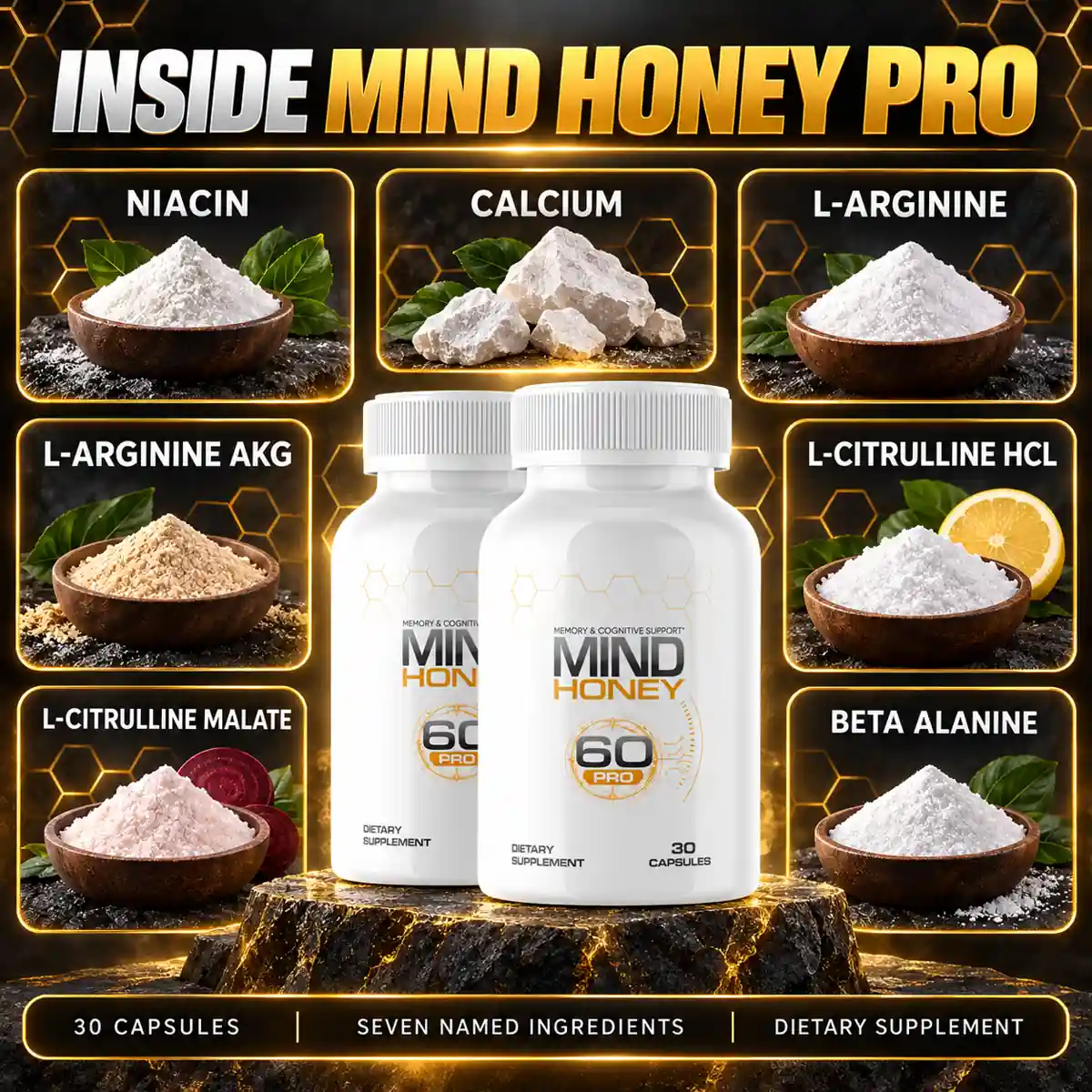
The panel itself makes the question easy to ask. The Supplement Facts panel prints seven rows with an amount against each: niacin 7.5 mg NE, calcium 18 mg, two arginine rows at 200 mg each, two citrulline rows at 100 mg each, and beta-alanine 40 mg. Serving size is one capsule and a bottle holds 30. Because every figure is printed, every figure can be held up against what a diet supplies. That is a small courtesy from the label and it is worth using.
This article does the holding-up for the three amino acid groups. Niacin and calcium have their own articles, one on the 47% figure and one on the calcium row, and food plays a different role for each of them.
A word on what kind of article this is. It is arithmetic and reading, not a recommendation to eat or avoid anything. Every number below comes from the printed label or from a paper you can open, and none of those papers measured memory.
Arginine: the diet already supplies grams
Start with the one that is easiest to size. An analysis of the Third National Health and Nutrition Examination Survey put mean arginine intake for US adults at 4.40 g a day, with a quarter of people eating less than 2.6 g. That is a national survey of noninstitutionalized adults, so it describes a whole population rather than a careful eater or a careless one.
Now the panel. Two rows carry arginine: L-Arginine (base) at 200 mg, and L-Arginine AKG 2:1 Extract at 200 mg. The second is a salt with alpha-ketoglutarate, so it delivers somewhat less than 200 mg of arginine itself. Even if you count the whole 400 mg as arginine, it is 0.4 g against a national mean of 4.4 g. That is about nine per cent. Set it beside the bottom quarter of eaters, who take in under 2.6 g, and it is about fifteen per cent.
In plain terms: a capsule a day adds an amount of arginine that is small beside what the survey says people already eat. It does not change what kind of arginine eater you are.
| Measure | Figure | Where it comes from |
|---|---|---|
| Mean US adult arginine intake | 4.40 g a day | The national survey analysis linked above. |
| Bottom quarter of intakes | Under 2.6 g a day | Same analysis. |
| Both arginine rows on the panel | 400 mg (0.4 g), counting the salt as if it were all arginine | The printed panel. |
| Panel as a share of the mean | About 9% | 0.4 divided by 4.4. |
| Panel as a share of the bottom-quarter line | About 15% | 0.4 divided by 2.6. |
The last two rows are this desk’s division, not a finding of the survey. They will overstate the capsule’s share slightly, because the AKG row is not pure arginine.
There is one more paper worth knowing about, because it asks whether the arginine in a diet leaves a trace in the blood. A population study of 2,771 adults in Tehran found that people in the top quarter of dietary arginine intake had higher serum nitrate plus nitrite, a marker of nitric oxide metabolism, and that the link was stronger in middle-aged and older adults. It is a cross-sectional study, so it cannot say that arginine caused anything, and a blood marker is not a memory score. What it does say is that ordinary food arginine is not invisible to the pathway the panel is named for.
Citrulline: watermelon is the famous source, and the figures are published
Citrulline takes its name from the watermelon, and the fruit really is a rich natural source. A chemical analysis of watermelon tissues measured citrulline at 1.9 mg per gram of fresh flesh and 1.3 mg per gram of fresh rind. On a dry-weight basis the range across varieties was 3.9 to 28.5 mg per gram, and the yellow and orange types ran higher than the red. So the fruit is not a fixed quantity, and any single watermelon figure carries that spread with it.
The panel prints two citrulline rows: L-Citrulline HCl at 100 mg and L-Citrulline Malate at 100 mg. That is 200 mg of salts, and the citrulline inside them is less than 200 mg because part of each weight is the hydrochloride or the malate. Taking the generous view and counting all 200 mg, and using the 1.9 mg per gram flesh figure, 200 mg of citrulline sits in about 105 g of watermelon flesh. That is a little under four ounces, a modest wedge.
So on the citrulline rows, the honest summary is that a wedge of watermelon matches the capsule. The capsule is not doing something exotic. It is delivering, in a fixed and portable amount, what a small piece of fruit contains.
What the feeding trial used
The more interesting question is what happens at larger intakes, and a randomized crossover feeding study answers it. Healthy adults consumed a controlled diet plus 0, 780 or 1,560 g of watermelon juice a day for three weeks, which supplied 1 g and 2 g of citrulline a day. Fasting plasma arginine rose 12% at the lower dose and 22% at the higher one, and ornithine rose 18% at the higher dose. Fasting citrulline itself stayed stable, which the authors read as the citrulline being effectively converted to arginine.
Two things follow. First, the amounts that moved a blood measure were one to two grams of citrulline a day, which is five to ten times what the two citrulline rows supply. Second, the outcome was a fasting blood level in healthy adults, not a cognitive test. Neither the panel nor this article claims that a rise in plasma arginine improves memory, and the trial did not ask.
Every arithmetic step above quietly favours the capsule, because it counts the whole printed 200 mg as citrulline and the whole 400 mg as arginine. The real figures are lower. That leaves the conclusion intact and, if anything, strengthens it: the amounts on this panel are small beside food.
Beta-alanine: it comes packaged as carnosine, and the diet effect is murky
Beta-alanine is the odd one out, because you do not eat it so much as you eat things that release it. It is the building block of carnosine, a dipeptide found in high concentrations in skeletal muscle, and animal foods are where the dietary supply comes from. A metabolomics study found that urinary anserine, a close relative of carnosine, separated omnivores from vegetarians very well, which is a roundabout way of confirming that meat is where these dipeptides come from.
Whether eating more of them changes what is stored in the body is where it gets messy, and the papers do not agree neatly.
- A study of 149 healthy people measured carnosine in three leg muscles by magnetic resonance spectroscopy. Vegetarians had 26% less in one of them, the gastrocnemius, than omnivores did. Women had less, and so did older people in one of the muscles. But among omnivores there was no difference between those with a high and a low estimated beta-alanine intake.
- A review of what determines muscle carnosine describes vegetarians as limited by the liver’s own synthesis of beta-alanine, while in omnivores dietary dipeptides add to that, giving muscle levels two or more times higher.
- A six-month randomized trial in 40 omnivorous women switched some of them to a vegetarian diet. Muscle carnosine did not change over six months on the vegetarian diet alone, although it rose when a beta-alanine and creatine supplement was added.
- A 2023 study of 60 healthy omnivores compiled the beta-alanine content of common foods, then compared three-day food records against measured muscle carnosine and found no evidence of an association. The authors suggest that changing carnosine through diet may be limited, and that supplementation may be needed for larger changes.
Put those together and the fair reading is that meat is a real source, that people who avoid it tend to carry less, and that within people who do eat it, self-reported intake does not sort them. That is a description of muscle, measured mostly in people interested in exercise. It says nothing about the brain, and nothing about what 40 mg does or does not do for anyone’s memory.
What it does let this desk say is where 40 mg sits on the dose scale. The International Society of Sports Nutrition position stand reports that four weeks at 4 to 6 g daily augments muscle carnosine. Forty milligrams is one per cent of the low end of that. The beta-alanine article covers what that gap means for the cognition trials.
Mind Honey Pro prints the amounts this arithmetic needs
Seven rows, seven printed amounts, one capsule a day and thirty to a bottle, with 180 days from the date of purchase to change your mind. The panel is small beside a normal diet, and this desk would rather say so than let you find out.
Two bottles $158 · six bottles $294 · 180-day money-back guarantee
Order Mind Honey Pro On The Official WebsiteOne capsule a day · 30 per bottle · lot MIN-26/MI-4229
The three amino acid groups side by side
| Panel rows | Printed | What food or a trial supplies | How the two compare |
|---|---|---|---|
| Arginine (base) plus arginine AKG | 200 mg + 200 mg | About 4.4 g a day is the mean US adult intake. | The panel is about a tenth of ordinary intake. |
| Citrulline HCl plus citrulline malate | 100 mg + 100 mg | About 1.9 mg per gram of fresh watermelon flesh. The blood-level trial gave 1 to 2 g a day. | The panel matches roughly 100 g of flesh, and is a fifth to a tenth of the trial amounts. |
| Beta-alanine | 40 mg | Comes as carnosine in meat. The sports protocol runs 4 to 6 g a day. | The panel is about 1% of the protocol, and food records do not predict muscle carnosine. |
Ratios are this desk’s arithmetic on printed figures. They assume the whole printed weight is the amino acid, which flatters the capsule.
Why none of this makes the capsule and the plate rivals
It is tempting to read the table as a verdict: the diet supplies more than the capsule, so the capsule is pointless. That does not follow, and it is worth being careful about why not.
The first reason is that the table compares intake, not what anybody needs. No Daily Value has been established for arginine, citrulline or beta-alanine, which is why five rows on the panel carry a dagger instead of a percentage. With no reference amount to measure against, a large dietary figure does not prove that more is unnecessary, just as a small capsule figure does not prove it is useless.
The second is that the panel never claims to replace a diet. The front of the bottle says memory and cognitive support and nothing on it suggests eating differently. The capsule is a fixed amount taken at a fixed time, and the plate is a variable amount arriving whenever dinner does. Those are different products with different behaviour, and only one of them can be counted in a diary.
The third is the one that matters most. The dose that food supplies is not the dose that anybody has tested for cognition. The trials this site discusses used capsules, powders or juice at gram amounts, in specific populations, over weeks. A diet is a different intervention with different companions. If the food-first reader takes one thing from this, it should be that neither the plate nor the capsule has been shown to do for memory what this panel’s name suggests.
What a food-first reader can do with this
Nothing here needs a purchase, which is a pleasant change for an article on a shop’s own website. If the question is whether you already get the amino acids on this panel, the answer for most adults eating protein foods is yes, arginine in the grams and citrulline and beta-alanine in whatever amounts the plate happens to hold.
- Know which food the citrulline figures describe. Watermelon is the dietary source the papers measure. None of the papers read for this article measured citrulline in a typical whole diet, so this desk will not guess at what yours contains.
- Know that carnosine is the messy one. The 149-person study found less muscle carnosine in vegetarians and, in one muscle, in older people, though a six-month vegetarian switch did not change it in the randomized trial, so the picture is not simple.
- Do not read the arginine figure as a target. It is a population average, and the survey’s own title says intake varies with demographics and lifestyle. Nothing in these papers names an amount that memory needs.
- Treat any capsule as an addition to what you eat, not a substitute for it. The label’s own caution says the same thing in a different way: do not exceed the recommended dose, and anyone with a known medical condition, or who is pregnant or nursing, should ask a physician first.
- If you take a blood pressure medicine, mention the bottle to your prescriber. The article on blood pressure and memory sets out why.
What the printed amounts made possible
The whole comparison rests on something small that is easy to miss. This label prints an amount against every active. A proprietary blend prints a total weight and a list, and the split is kept private. With a blend you could not divide 400 mg by 4.4 g, or ask whether 200 mg of citrulline is a wedge of fruit, because you would not know whether the citrulline was 200 mg or 20.
The disclosure cuts against the product as often as for it. Here it shows that the arginine rows are modest beside a normal diet and that the beta-alanine row is a hundredth of the sports protocol. A website that only wanted to sell a bottle would have left the arithmetic to the reader. This one does it on the page, because a buyer who understands what a row is can make a fair decision about it.
If you would like the rows compared with the amounts their own trials used, the ingredients page does that row by row, and the article on the four amino acid rows explains why the panel splits arginine and citrulline in two.
Mind Honey Pro is a dietary supplement for healthy adults of eighteen and over, not a drug, and it is not FDA-approved. Nothing above is dietary advice for any person, and none of the papers cited measured memory. Anyone managing a medical condition, taking regular medication, pregnant or nursing should ask a physician or dietitian before changing what they eat or take.
References
- King DE, Mainous AG, Geesey ME. Variation in L-arginine intake follow demographics and lifestyle factors that may impact cardiovascular disease risk. Nutr Res. 2008;28(1):21-4. PMID 19083383. https://pubmed.ncbi.nlm.nih.gov/19083383/
- Mirmiran P, Bahadoran Z, Ghasemi A, et al. The Association of Dietary l-Arginine Intake and Serum Nitric Oxide Metabolites in Adults: A Population-Based Study. Nutrients. 2016;8(5):311. PMID 27213443. https://pubmed.ncbi.nlm.nih.gov/27213443/
- Rimando AM, Perkins-Veazie PM. Determination of citrulline in watermelon rind. J Chromatogr A. 2005;1078(1-2):196-200. PMID 16007998. https://pubmed.ncbi.nlm.nih.gov/16007998/
- Collins JK, Wu G, Perkins-Veazie P, et al. Watermelon consumption increases plasma arginine concentrations in adults. Nutrition. 2007;23(3):261-6. PMID 17352962. https://pubmed.ncbi.nlm.nih.gov/17352962/
- Cuparencu C, Rinnan Å, Silvestre MP, et al. The anserine to carnosine ratio: an excellent discriminator between white and red meats consumed by free-living overweight participants of the PREVIEW study. Eur J Nutr. 2021;60(1):179-192. PMID 32246262. https://pubmed.ncbi.nlm.nih.gov/32246262/
- Everaert I, Mooyaart A, Baguet A, et al. Vegetarianism, female gender and increasing age, but not CNDP1 genotype, are associated with reduced muscle carnosine levels in humans. Amino Acids. 2011;40(4):1221-9. PMID 20865290. https://pubmed.ncbi.nlm.nih.gov/20865290/
- Harris RC, Wise JA, Price KA, et al. Determinants of muscle carnosine content. Amino Acids. 2012;43(1):5-12. PMID 22327512. https://pubmed.ncbi.nlm.nih.gov/22327512/
- Blancquaert L, Baguet A, Bex T, et al. Changing to a vegetarian diet reduces the body creatine pool in omnivorous women, but appears not to affect carnitine and carnosine homeostasis: a randomised trial. Br J Nutr. 2018;119(7):759-770. PMID 29569535. https://pubmed.ncbi.nlm.nih.gov/29569535/
- Rezende NS, Bestetti GC, Farias de Oliveira L, et al. Dietary β-Alanine Intake Assessed by Food Records Does Not Associate With Muscle Carnosine Content in Healthy, Active, Omnivorous Men and Women. Int J Sport Nutr Exerc Metab. 2023;33(3):133-140. PMID 36963409. https://pubmed.ncbi.nlm.nih.gov/36963409/
- Trexler ET, Smith-Ryan AE, Stout JR, et al. International society of sports nutrition position stand: Beta-Alanine. J Int Soc Sports Nutr. 2015;12:30. PMID 26175657. https://pubmed.ncbi.nlm.nih.gov/26175657/