Mind Honey Pro Official Website › Blog › Memory Changes Worth An Appointment
The Memory Changes That Are Worth An Appointment
This is the article on this website that costs the product the most, and it is the reason the other four are worth reading. Several of the commonest causes of a memory change are found by asking a few questions, and a supplement rules out none of them.
- Ordinary forgetting and the other kind look different, and the differences are describable.
- Sleep apnoea, hearing loss, thyroid function, B12, depression, medicines and alcohol all affect memory and are all found by asking.
- An initial assessment is a conversation, a short cognitive screen and a few blood tests. It is not an ordeal.
- Getting lost somewhere familiar, losing common words, or a family member noticing first are reasons to be seen rather than to start a capsule.
- A supplement has a legitimate place, and the place is after the appointment rather than instead of it.
Ordinary forgetting and the other kind
Everybody forgets things, and forgetting more at sixty than at thirty is ordinary. Names go first, then where things were put, then why you walked into the kitchen. None of that is unusual and almost all of it improves with sleep.
The other kind is different in character rather than in quantity. It is not that more is forgotten; it is that new information fails to stick at all, or that something familiar becomes unfamiliar.
The distinction matters because it decides what to do next. Ordinary forgetting is annoying and worth managing. The other kind is worth an appointment, and several of its causes are treatable if they are found.
The changes that should not wait
| What is happening | Why it is different |
|---|---|
| Getting lost somewhere familiar | Spatial disorientation in known surroundings is not ordinary forgetting. |
| Losing ordinary words rather than proper nouns | Forgetting a name is common. Losing the word for a common object is not the same thing. |
| A family member noticing before you do | Loss of insight is itself a signal, and it is the most reported route to a first appointment. |
| Repeating the same question within a conversation | This is about new information failing to stick rather than old information being slow to surface. |
| A sudden change over days or weeks | Speed matters. A rapid change is a reason to be seen soon rather than at the next convenient moment. |
| New confusion alongside a fever, a fall or a new medicine | These have their own causes and their own urgency. |
This table is not a diagnostic tool and cannot be used as one. It is a list of reasons to make an appointment.
None of those means dementia. Several of them have ordinary explanations and some have urgent ones, and telling the difference is precisely what an examination is for.
What they have in common is that no supplement, this one included, is an answer to any of them.
What an initial assessment actually involves
People put this off because they imagine a scan and a verdict. A first appointment is usually none of that.
It is a conversation about what has changed and over what period, often with a family member present because they notice different things. There is a short cognitive screen, which takes about ten minutes and is a set of simple tasks rather than an examination you can fail. There is a review of every medicine in the cupboard, including the ones bought without a prescription. And there are a few blood tests.
Most of the work-up is about ruling in the things that can be fixed. That is why it is worth doing early, and why doing it after a year of capsules is a year later than it needed to be.
The one number worth having
Whatever is or is not found, an appointment produces a baseline: a score, a date and a description in a record. Everything afterwards is measured against it.
That is the thing a supplement can never supply, and it is worth more than any capsule in this category.
The causes that are found by asking
| Cause | How it is found | What can be done about it |
|---|---|---|
| Obstructive sleep apnoea | A conversation and a sleep study | Treatment improves daytime alertness and concentration, and it is one of the most commonly missed causes. |
| Untreated hearing loss | A hearing test | Straining to hear costs attention all day, and attention is what most people are describing when they say memory. |
| Thyroid function | A blood test | Correctable, and routinely checked in this work-up. |
| Vitamin B12 status | A blood test | Correctable, and worth checking in older adults. |
| Depression and anxiety | A conversation | Both impair concentration and recall, and both are treatable. |
| Medicines already in the cupboard | A review of the list | Anticholinergics, sedatives and several common prescriptions affect memory. |
| Alcohol | An honest answer to a question about units | Reversible in many cases, and rarely volunteered without being asked. |
Every row is found by asking or by a routine test. None of them is ruled out by a year of any capsule.
Read that table and the shape of the argument is obvious. Seven common contributors, all of them identified by a conversation or a routine test, and several of them substantially reversible.
A year of any supplement leaves every one of those rows exactly where it was.
Hearing loss, the one most often missed
This deserves its own section because it is so often mistaken for memory by the person experiencing it and by everyone around them.
If you cannot quite hear what was said, you cannot encode it, and what you cannot encode you cannot recall. From the inside that feels exactly like forgetting. From the outside it looks like inattention.
The effort of following conversation in a noisy room with reduced hearing also consumes attention that is then unavailable for anything else, which is why people describe themselves as foggy after a dinner rather than after a quiet evening.
A hearing test is quick, widely available and often free. It is among the highest-value things on this page.
Mind Honey Pro is for after the appointment, not instead of it
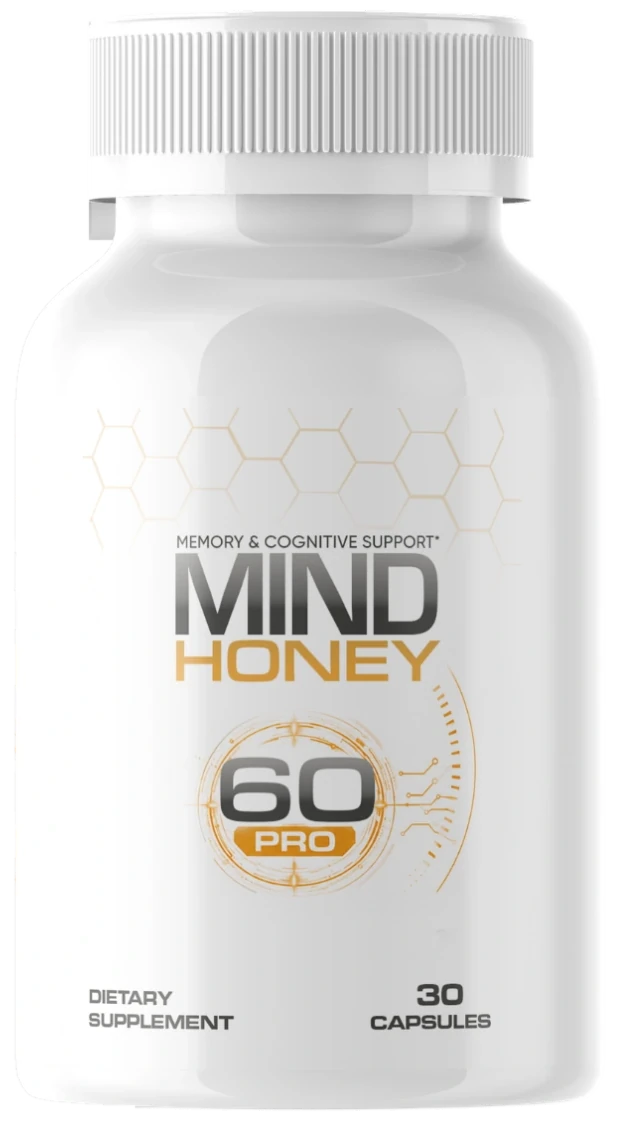
Seven actives with every amount printed, one capsule a day and 180 days from purchase to change your mind. The bottle supports memory and cognitive function; it does not answer the question an assessment answers.
Two bottles $158 · six bottles $294 · 180-day money-back guarantee
Order Mind Honey Pro On The Official WebsiteOne capsule a day · 30 per bottle · lot MIN-26/MI-4229
What a supplement can and cannot do here
The honest boundary is narrow and it is worth drawing precisely rather than piously.
What a supplement in this category may claim is support for a normal function. What it may not claim, and what this desk will not imply, is any effect on dementia or on the course of a diagnosed condition. That is not modesty; it is the rule that governs the whole category, and a company casual about it is not a safe bet on anything else either.
The evidence position is equally narrow. The one cognition literature behind an ingredient on this panel is an observational cohort of dietary intake over years. A randomised trial of a different NAD precursor gave 1 g a day to older adults with mild cognitive impairment, which is the shape of the hypothesis rather than support for a vitamin row.
And the premise behind the rest of the formula has been tested directly. A thirteen-week randomised trial in older adults raised dietary nitrate and changed neither cerebral blood flow nor cognitive function. That result is on this website because leaving it out would be the dishonest choice.
One genuine caution belongs here too, and it runs the other way. A population study in women with cerebrovascular disease found an association between calcium supplementation and dementia risk, at supplemental doses measured in hundreds of milligrams. The calcium on this panel is 18 mg, far below that, and the finding is reported here because a reader is entitled to it rather than because it applies to this capsule.
Six things that help and cost nothing
These come up in every set of general advice on the subject, they are free, and several work faster than anything sold in a capsule.
- Treat sleep as the first intervention. Nothing on a supplement panel competes with two extra hours a night, and snoring with daytime sleepiness is worth mentioning at the appointment.
- Get your hearing checked. See the section above. It is the highest-value item on this list.
- Look honestly at alcohol. It affects memory directly and sleep indirectly, and the effect is often larger than people expect.
- Read the labels in the medicine cupboard. Sedatives, some antihistamines and a number of prescriptions with anticholinergic effects all contribute.
- Keep moving, and keep talking to people. Both track with cognitive outcomes across the observational literature, and both help several other things at once.
- Write things down. Not a treatment, but it removes the daily friction that makes the problem feel larger than it is.
Taking a record to the appointment
A short written record makes a first appointment twice as useful, and it takes a week to prepare.
- What changed, described concretely, with an approximate date it started.
- Whether it came on gradually or over days.
- Every medicine and supplement currently taken, including this one.
- What a family member has noticed, in their words rather than yours.
- Sleep: hours, quality, snoring, daytime sleepiness.
- Alcohol, honestly, in units per week.
That list separates a person whose sleep has been broken for two years from a person whose recall changed over a fortnight. Those two need different things, and no capsule distinguishes between them.

Where a supplement legitimately fits
None of this is an argument that a memory supplement is pointless. It is an argument about the order things happen in.
After an assessment, with a baseline on file and nothing structural found, a person told that monitoring is reasonable has a real decision to make. Taking something that supports normal function while they watch it is a defensible choice, and it is precisely the space the one claim on this bottle describes.
What this desk will not do is pretend the capsule is the first step. Three other articles here work through the amounts at length: the beta-alanine row against its trials, what a percentage column buys and why two ingredients get four rows. Every one of those assumes the reader already knows what they are treating.
So: get it looked at once. Then read the ingredients page, weigh the seven amounts against the research printed beside them, and decide with a number in your hand rather than an impression.
Mind Honey Pro is a dietary supplement for healthy adults of eighteen and over, with no FDA approval, and it is not intended to diagnose, treat, cure or prevent any disease, dementia included. Nothing written above can tell you what is causing your symptoms, and none of it stands in for an examination. Anyone taking a blood pressure medicine has a specific reason to mention this bottle to their doctor, because arginine and citrulline lower blood pressure at gram doses.
References
- Morris MC, Evans DA, Bienias JL, et al. Dietary niacin and the risk of incident Alzheimer's disease and of cognitive decline. J Neurol Neurosurg Psychiatry. 2004;75(8):1093-9. PMID 15258207. https://pubmed.ncbi.nlm.nih.gov/15258207/
- Orr ME, Kotkowski E, Ramirez P, et al. A randomized placebo-controlled trial of nicotinamide riboside in older adults with mild cognitive impairment. Geroscience. 2024;46(1):665-682. PMID 37994989. https://pubmed.ncbi.nlm.nih.gov/37994989/
- Kern J, Kern S, Blennow K, et al. Calcium supplementation and risk of dementia in women with cerebrovascular disease. Neurology. 2016;87(16):1674-1680. PMID 27534711. https://pubmed.ncbi.nlm.nih.gov/27534711/
- Babateen AM, Shannon OM, O'Brien GM, et al. Incremental Doses of Nitrate-Rich Beetroot Juice Do Not Modify Cognitive Function and Cerebral Blood Flow in Overweight and Obese Older Adults: A 13-Week Pilot Randomised Clinical Trial. Nutrients. 2022;14(5):1052. PMID 35268027. https://pubmed.ncbi.nlm.nih.gov/35268027/
- Khalaf D, Kruger M, Wehland M, Infanger M, Grimm D. The Effects of Oral l-Arginine and l-Citrulline Supplementation on Blood Pressure. Nutrients. 2019;11(7):1679. PMID 31336573. https://pubmed.ncbi.nlm.nih.gov/31336573/